
Greenwashing is arguably one of the most pernicious developments at a time when we need urgent climate action. Social media has a big role here, and from a demand perspective, greenwashing stories consistently sell.
It concerns us all because greenwashing:
- Misleads your choices. You pay extra for “sustainable” without getting the real ecological benefits.
- Undermines real climate action. It dilutes trust in genuine environmental efforts.
- Hurts honest brands and innovators. When everyone claims to be green, the genuinely green get lost in the noise.
That’s why Climate Action Live is bringing you this series on greenwashing. Follow this space where our experts will fact-check green claims so that you can make smarter buying choices.
This first part of our series explains what rules and guidelines exist against greenwashing, and how you can take action under them.
Consumer protection guidelines
Under India’s Central Consumer Protection Authority Guidelines (2024), greenwashing is “any deceptive or misleading practice… by exaggerating, making vague, false, or unsubstantiated environmental claims” or using imagery to hide harmful effects of products/services.
The guidelines intend to make environmental claims truthful, transparent and verifiable.
Key features:
- Clear definitions: What counts as an “environmental claim” and what doesn’t.
- Ban on vague buzzwords: Claims like “eco-friendly,” “green,” “sustainable,” “good for the planet,” “carbon neutral” must be backed by solid evidence.
- Evidence & disclosures: Companies must show the methodology, data and credible proof behind their claims or third-party certificates.
- No hiding facts: Emphasizing the good while concealing harmful attributes is prohibited.
These guidelines provide for penalties and enforcement (under the Consumer Protection Act of 2019 – meaning violators can face action if they breach the rules.
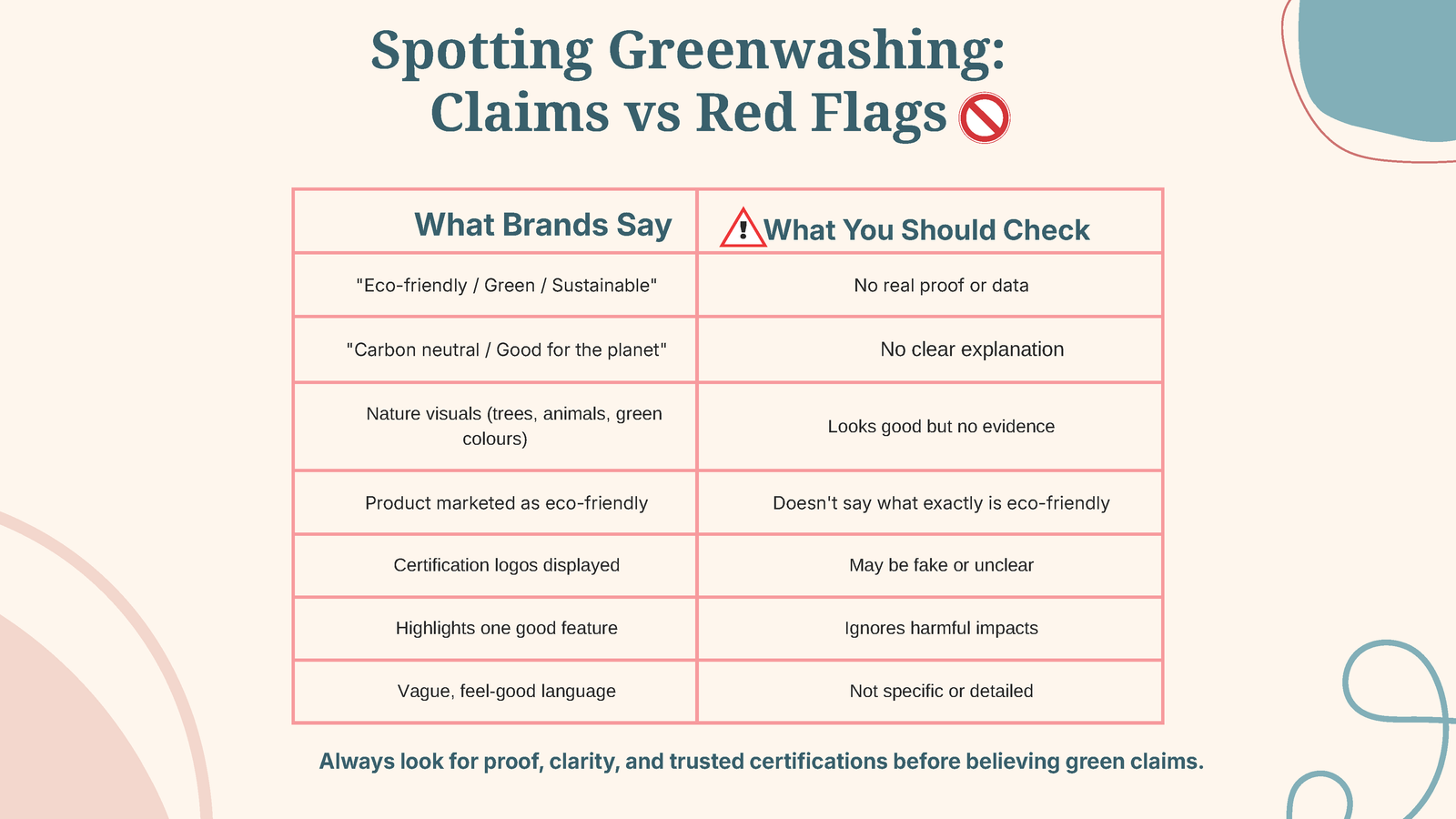
Infographic by Riddhi Singhal
Where to file a complaint:
Advertising council’s guidelines
The Advertising Standards Council of India (ASCI) also has Guidelines for Advertisements Making Environmental/Green Claims, which have been effective since February 15, 2024.
These require ads to:
- Be specific: Only claim environmental benefit for parts that are genuinely green.
- Use accredited certifications: No vague logos or symbols without proof.
- Avoid misleading visuals: Green colors or nature imagery shouldn’t imply benefits that don’t exist.
If ASCI sees a violation, it can urge the advertiser to withdraw the ad, and even escalate to regulatory authorities like the CCPA.
Where to file a complaint: https://www.ascionline.in/complaint-faq/
What’s happening globally?
Across the world, regulators are tightening the screws on greenwashing. The European Union’s Green Claims Directive (2024) sets strict standards for substantiating sustainability claims, banning generic terms without evidence. In the United States, too, the Federal Trade Commission (FTC) has Green Guides encouraging clear disclosures and has taken action against misleading claims (e.g., through lawsuits and enforcement actions).
In many jurisdictions, activists and courts are also stepping in — for example, French courts fined energy companies for deceptive carbon neutrality claims.
What we can do, together
With stronger rules now in India and around the world, your awareness and voice matter more than ever.
Together, we can learn to spot the red flags, such as:
- Use of vague buzzwords with no proof.
- Heavy reliance on imagery of nature or animals without data.
- No specifying what part of a product is green.
- No information whether the claim has been independently certified
- Lack of detailed data about environmental impact
For communicators, here’s a handy guide to preventing greenwashing.